
film noir & the death of happy ending
There is a certain type of hangover that has nothing to do with alcohol. It’s when you’ve just watched a movie, the credits are rolling and the lights have come up. Instead of that clean and aerobic feeling feeling of a properly resolved story, with the villain punished, lovers reunited and the world back to its factory settings, there is a feeling closer to the morning after a bad decision.
Like a low-grade nausea, or a residue. You can’t quite locate the problem, but something has been taken from you and you aren’t getting it back. Welcome to film noir. Pull up a barstool. You’ll be here a while.
Film noir didn’t arrive with a manifesto, or announce itself at Cannes with a press kit and Q&A. It seeped in through the cracks of post-war disillusionment. Through the cigarette smoke of those writers who had seen enough of the world to stop believing the ending was ever going to be like the one they’d been promised. The French critics named it, of course they did, as they recognised in those shadowed American crime movies something the Americans themselves couldn’t quite admit to: that they were making art about a society that had already broken its own promises.
That most American of inventions, the Hollywood ending, was supposed to be the deal. You sit there in the dark for two hours, invested in the fight, and the machinery of narrative delivers justice like a vending machine giving out candy. It’s reliable. Transactional. Comforting in the predictability. Noir looked hard at that machine, lit a cigarette, and walked the other way.

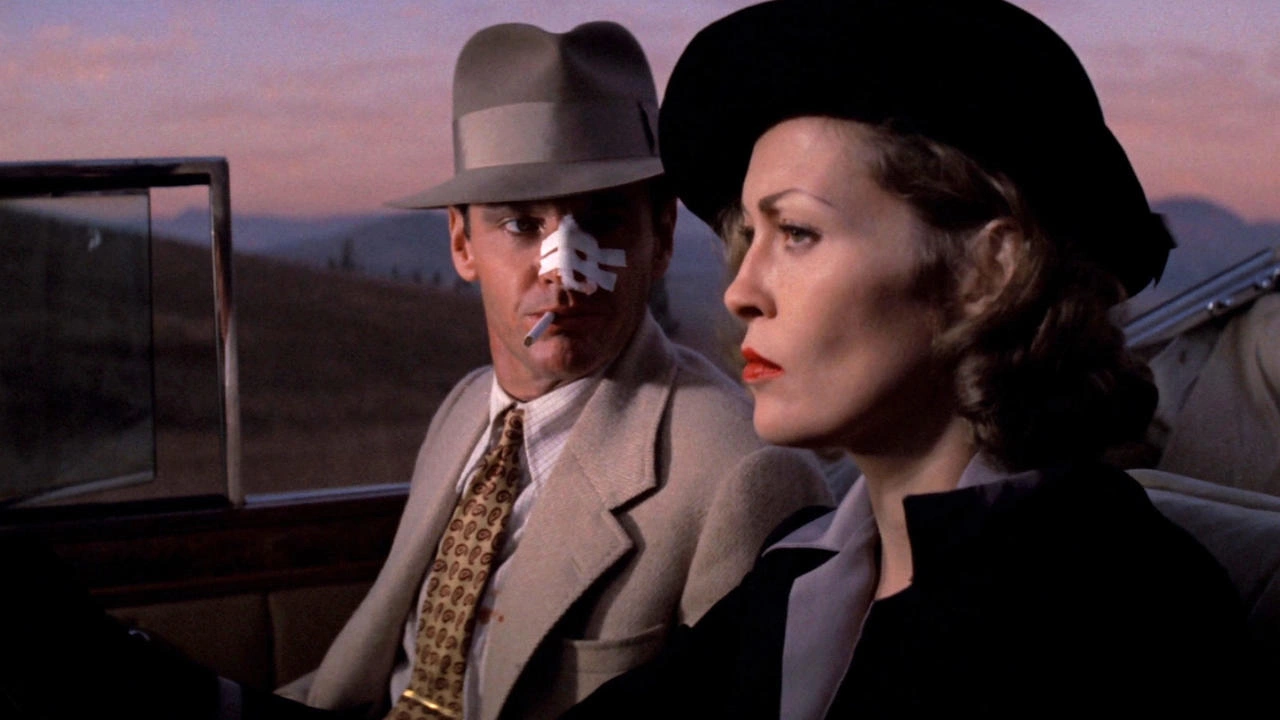
Chinatown and
the Collapse of Justice
Think of Jake Gittes at the end of Chinatown. Roman Polanski understood something crucial about the DNA of the genre, even as a latecomer to it. Jake is a detective, a man whose whole professional identity is based around the revelation of truth. He is competent and clever. He figures things out. And in the final minutes of the movie, all he’s figured out is used against him and his knowledge becomes the instrument of catastrophe.
Evelyn Mulwray has been shot dead by the police, Noah Cross, a man who has done things to his own daughter that the movie can barely name, walks off into the night carrying a child who is both his daughter and granddaughter.
Jake’s partner then delivers the eulogy: “Forget it, Jake. It’s Chinatown.”
The audience sits there, gutted. We wait for the reversal which doesn’t come. Because that’s the thing about noir refusing catharsis; it’s not nihilism for its own sake. It isn’t just the director pulling the tablecloth to watch the dishes smash on the floor.
It’s a diagnosis: power protects itself. Corruption is structural, not incidental. The righteous detective is a beautiful but doomed idea, like a good marriage in a Raymond Chandler novel. It’s something you want to believe in, and occasionally exists, but the world is not fundamentally organised to support.
Double Indemnity and
the Point of No Return
Film noir understood something about innocence that the surrounding culture was hesitant to admit: it doesn’t get restored, it gets used up.
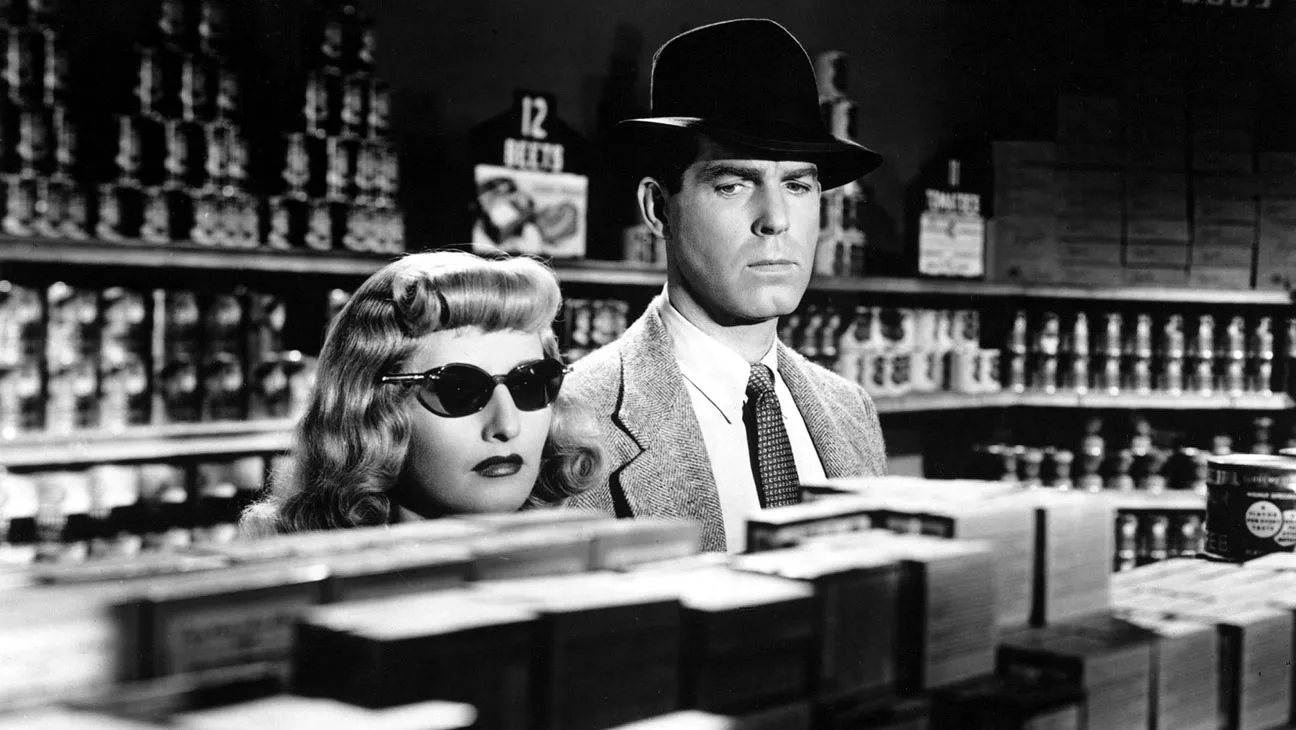
At the beginning of Billy Wilder’s masterpiece, Double Indemnity, Walter Neff is not a bad man. He’s a pretty decent insurance salesman who makes one fatal mistake in the presence of an ankle bracelet and a woman who knows just what she’s doing.
By the end, he’s bleeding to death in his own office, recording his confession into a Dictaphone, and what’s striking isn’t the punishment, but the lucidity. He knows, he knew somewhere along the way and just kept going. The great subject of noir isn’t crime. It’s that moment after you’ve already chosen wrong and decided to go through with it anyway. That isn’t a satisfying ending, but it is an honest one.
The genre is filled with people who have eaten from the wrong tree. Phyllis Dietrichson is dead, Walter Neff is dying, and the money is lying somewhere uncollected. Yes, justice arrives, but it feels like a demolition crew taking the whole building down. There are no survivors to feel vindication. Catharsis needs someone left standing to receive it.
The Femme Fatale
The femme fatale, a lazily named and deeply misunderstood figure, is a monument to the genre’s refusal of comforting resolution. She has been called male anxiety made flesh, which is partly true and almost totally uninteresting. What’s more exact is that she represents what happens when desire and intelligence have nowhere legitimate to go.
In a world which has organised itself to keep particular people powerless, she weaponises what’s available to her, and the men around her, credulous, romantic, and way too confident in their ability to read a room, walk face first into the machinery.
She rarely wins. But, crucially, she doesn’t lose cleanly either. Her endings veer towards the operatic: dead on a staircase, or behind bars and staring at nothing, disappearing into a narrative that has no more use for her complexity.
As an audience, we are not given the satisfaction of her triumph, or the clean moral comfort of her punishment feeling deserved. What we’re left with is something murkier: a sense that she was the most alive person in the movie, and that aliveness had to be snuffed out because the world shown just couldn’t accommodate it. That’s more than a genre convention. That’s a social document.

The City, Power and the Illusion of Resolution
The cities shown in film noir are their own argument against catharsis. They aren’t the bright, legible metropolises of civic mythology. They are places where the light arrives at an angle specifically designed to create a shadow, and where every wet street at midnight looks like a mirror reflecting something worse than your own face. The architecture in noir is the architecture of a world without exits.
Raymond Chandler, who maybe understood the territory better than anyone, wrote about Los Angeles in the same way a coroner writes about the cause of death; with professional detachment hiding real grief.
Phillip Marlowe solves the crime, every time. He’s the closest thing noir has to a Knight errant. Yet every resolution dumps him back in in the same city, unchanged by the victory which wasn’t really a victory. More like a temporary arrangement. A stay of execution for a civilisation that’s already made its fatal choice. He exposes corruption which doesn’t collapse, but rebuilds. He’ll be back next week, the city will have a new body and the same old rot.
That isn’t a detective story. That’s the description of institutional failure but written in the grammar of genre fiction. It’s also a lot more honest about power than most political journalism.
Conclusion: Why Noir Refuses Catharsis
There’s a reason these movies found their moment in post-war America. A whole generation had just been through something that was supposed to be clean; with a righteous war, clear enemy and definitive ending.
Then they came home to ever-expanding suburbs that felt like stage shows, prosperity which felt purchased at a cost nobody had disclosed and to the growing, nameless suspicion that the machinery of the good life had a darker engine than the brochure advertised. Noir was the art form which said: yes, you’re right to feel that way, but no, we’re not going to make it any better.
Paradoxically, that kind of honesty is its own form of comfort, although it operates nothing like the conventional kind. When a movie refuses to let you off the hook, and refuses to hand you the easy resolution you’re trained to expect, it’s treating you like an adult.
It’s telling you: the world has injustice that cannot be resolved. Power sometimes wins and innocence, once surrendered, is gone. This is a story that won’t lie to you about any of this. Now sit with it, and see what it feels like.
What film noir understood at its core, and what the huge machinery of commercial cinema has always struggled to admit, is that catharsis is a type of forgetting. That release you feel at the end of a neatly resolved story is the emotional equivalent of the reset button. The tension drains away, injustice has been corrected, roll credits. You then walk back into the lobby having been, in a fundamental sense, let off the hook. You’ve processed and been cleansed.
Noir doesn’t want you cleansed. It wants you carrying something out of that cinema, like you carry the smell of the kitchen out of a restaurant, in your clothes and hair, noticing it later in the dark.
Because that residue, the low-grade unease and sense of something unresolved, isn’t a failure of the genre. It’s the whole point. It’s the insistence of the genre that the world has things which won’t resolve, and art that pretends otherwise is not comfort.
It’s just lying down in a dark room.

Author
Adam Page is a freelance writer, specialising in film and literature with essays and opinion pieces. He has a particular love for all things horror-related, being published in HorrorFam, FilmEast, MovieMarker among others. He is an Undergraduate, studying English Literature and Language, and enjoys taking movies apart, discovering the themes and techniques used to make cinema the incredible medium it is. If he isn’t writing an essay, he is usually found rewatching a movie, notebook in hand and annoying anyone who is sitting close by. Feel free to follow him on Instagram and BlueSky.

Film noir emerged in the early 1940s as a distinctive style within American cinema, marked by its dark, moody aesthetics and cynical narratives. The term “film noir” meaning…

Neo noir is a contemporary style that draws from the classic film noir genre from the 1940s and 1950s. Classic film noir became known post-World War II, characterized by…

German Expressionism stands out as one of the most distinctive styles in the era of silent film. Expressionism, as an artistic movement, originally emerged in poetry…
In the late 1960s and throughout the 1970s, until mid 1980s, a cinematic revolution unfolded in Hollywood that would forever change the landscape of the film industry. American New…

When a car bomb explodes on the American side of the U.S./Mexico border, Mexican drug enforcement agent Miguel Vargas begins his investigation, along with American…
In the early 20th century, a cinematic revolution was brewing in the Soviet Union. A group of visionary filmmakers, collectively known as the Soviet Montage School, gathered…