
spring night, summer night review
film by Joseph L. Anderson (1967)
The working class patriarch is bedeviled by contradictions which—barring willful consciousness-raising or the luck to suddenly be living in a nation not beholden to class stratification, each gradation-echelon boasting its unique neurosis-inducing approach to Performing Nuclear Propriety—ultimately render him ineffective.
Review by: James Carneiro | Filed Under: Film Reviews
December 21, 2025
Take Virgil Royer (John Crawford). Scrabbling and harried at his fall from mine to sub-sub-sub-sistence farming, he plays the hectoring patriarch who can never be satisfied. His wife, his blended children, even peripheral ex-lovers from decades ago, they are all failing him in some way. Within Virgil’s mind palace, there is a vaunted trophy case—presently empty, cobwebbed—with lonely placards reading MOST DUTIFUL DAUGHTER and MOST RESPECTFUL SON and WIFE WHO NEVER ASKS UNCOMFORTABLE QUESTIONS.
Obviously, the point of these trophies is their impossible standard; they are such glowing precious things to Virgil because fantasies are arbitrary, the goal posts will always be 10 yards downfield and then 20, 30, 40, finally exceeding Biblical Canaan’s city limits until one morning they abut the film department at Ohio State University. (A bespectacled professor takes notice. Unlike the other members of the Royer family—who wisely respond to Virgil’s impotent soliloquizing by simply ignoring him—Joseph L. Anderson wants to perform a psychosocial vivisection on this warped little tramp. 60’s independent filmmaking is all the richer for it.)
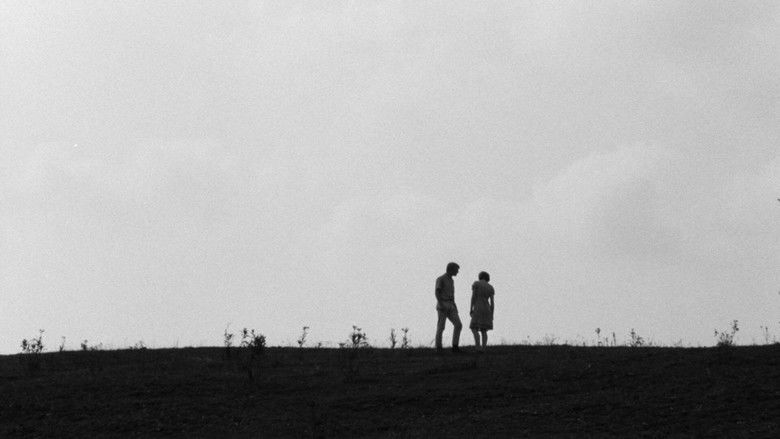
Both Virgil Royer and my father were unable to convincingly “perform” the thoughtless ease of the bourgeois patriarch. So they overcompensated with lip-trembling belittlement, sozzled soliloquy, idle threats, less idle slaps, kicks, Wedding Band Fists, the occasional Mashed Potatoes Rubbed In Hair With Cossack Glee.
Appalachian Ohio and Latino Hill Country were (are) quite similar; they couldn’t offer either patriarch work which wasn’t precarious, humiliating, spiritually deadening, physically degenerative, all at rates of pay which would be considered miserly in Interwar Estonia. My father and Virgil weren’t allowed to play the father they always imagined they’d embody. The perfidy of capitalist exploitation, the ever-shifting pettiness of geography and its boom-bust thralldom to market forces, this stymied their sitcom dream-wish. And so both men acted out. Like the pampered children they chopped wood and cleaned pools for.
Spring Night, Summer Night is refreshing. A less curious film would’ve relegated Virgil to hair-trigger ogre, the Royers cowering in one corner or another. He might eventually be bested—almost certainly by Carl in a fit of reverse-filial conquest—but While He Stands, His Word is Law. Not so in this film. No-one takes this wind-up loser seriously. His concave masculinity so petulant, his paternity so flaccid, the only reasonable response to his impotent remonstrance is to humor him. All he has left is complaining. The vaunted trophy case will remain forever empty—though lovingly polished—not just because of the arbitrariness of Performing Nuclear Propriety, but because “his” family has stopped playing. They’ve put away childish things.
They may fuck up incredibly, self-immolate down bleak avenues caps-locked in alarmist UNWED MOTHERHOOD or INADVERTENT HALF-INCEST or any number of youthful indiscretions which are cocktail fodder or resume padding or Inspirational Tales of Overcoming Adversity for the privileged and social death for working class kids. Or there may be splendor in the grass, inebriated honkytonk carousing, banzai charge motorcycle dawns, the gratifying self-knowledge you’ll always look hot in a bikini no matter how much Stroh’s you quaff or KFC you snarf, cupping and pawing across Chevy’s and dewy meadows and railroad trestle brooks, the entire Mephistophelean strip-mined topography made temporarily beautiful because the collective you willed it so.
Whether our assigned patriarch’s morbid premonitions come to pass (comically premised on the vagaries of fate directly correlating to our level of filial piety that particular day) or we really do find communal bliss out in Columbus (That Mecca On The Scioto) or (most likely) some combination of the two, we consciously and brazenly decided to quit performing in our fathers’ Neverland. We grew up. I wish I’d learned that the moment he smeared mashed potatoes in my hair; who was the child in that situation?

Author
Reviewed by James Carneiro. Initially caught the film bug while cruising for used copies of Bergman flicks/bootleg concert footage at Disc Replay. These days, he’ll review quite anything, though he is partial to Italian neorealism, American underground film, and whoever is using cinema as a method of interrogating power structures. You can follow him on Letterboxd and Twitter.
A 1993 British black comedy drama film starring David Thewlis as Johnny, a loquacious intellectual, philosopher and conspiracy theorist. The film won several awards…

Envisioned on the picturesque coast of Southern California and based on the book of the same title, the collaborative efforts to put Midnight Cowboy on screen resulted…
An alcoholic falls in love with and gets married to a young woman, whom he systematically addicts to booze so they can share his “passion” together. An Academy Award went…
In the late 1960s and throughout the 1970s, until mid 1980s, a cinematic revolution unfolded in Hollywood that would forever change the landscape of the film industry. American New…
In the aftermath of World War II, Italy was a country in ruins, both physically and economically. Amidst the rubble and despair, a group of visionary filmmakers arose to…
A cult film is a movie that builds a devoted following without achieving mainstream success or widespread critical praise at the time of its release. These films are…