
german expressionism & the birth of horror
Let’s talk about fear. Real fear. Not the cheap jump-scare variety, which is the cinematic equivalent of a stranger blasting their car horn at you, but the crawling, deep existential fear that gets into the marrow and stays there. It’s the fear which makes you question whether the walls of your apartment are leaning slightly, if the shadows in the corner have always been that shape and whether the man across the street has always been that man.
Fear like that has a birthplace and a year. It smells faintly of cigarette smoke and post-war despair in a place called Weimar Germany. It’s 1920 and Europe has recently finished destroying itself with an enthusiasm that would embarrass the most committed self-saboteur.
In particular, Germany is sitting in the rubble of its own ambitions. It is politically unmoored, economically gutted and spiritually emptied by the new horror of industrialised death. And into this cracked and tilting world, a group of movie-makers chose to make movies that looked just like how people felt.
Dr. Caligari:
the Expressionist Vision
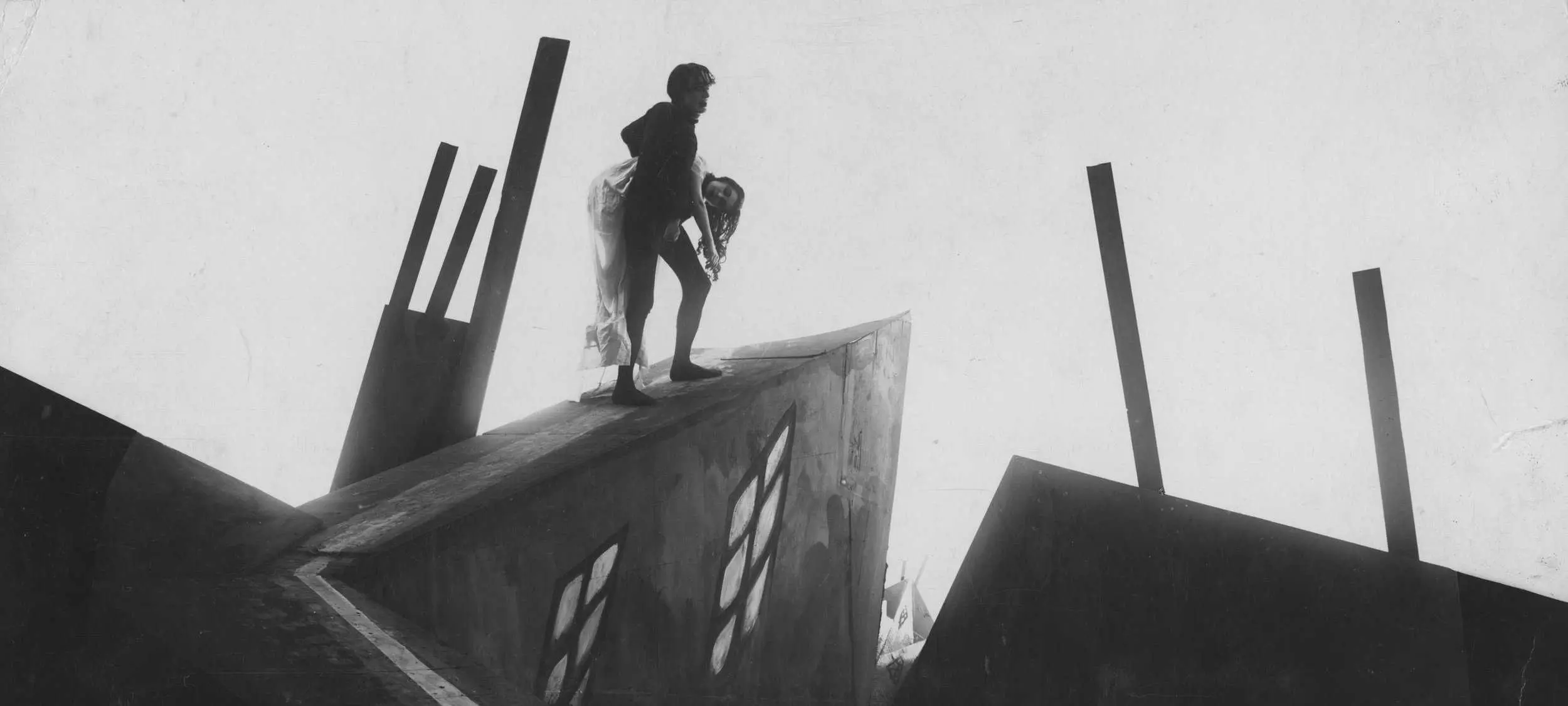
The Cabinet of Dr. Caligari (1920) by Robert Weine arrived like a fever dream which someone had the audacity to charge admission to. Architecturally, the sets don’t make sense. The streets are angled wrong. Doorways lean and staircases go places staircases shouldn’t. It looks as though the world has been painted by someone who can’t stop shaking. Which is exactly the point.
It wasn’t a technical limitation, it was a philosophy. A manifesto written in crooked geometry and shadow, telling us: the external world is a reflection of internal chaos. The Expressionists insisted the universe does not exist independently of the minds perceiving it. And those minds were terrified, broken, and magnificent.
The Expressionist movement itself predates cinema. We see it in Edvard Munch’s screaming figure, and in Ernst Ludwig Kirchner’s dream-like Berlin street scenes. We see it through the violent, jagged lines of a whole generation of painters who decided photographic realism was nothing but a lie. Real truth was always interior and psychological. The sky isn’t blue, but the colour of anxiety. The night isn’t dark, it’s the shape of what you’re afraid to name.
Nosferatu & Metropolis:
the Architecture of Horror
What German Expressionist directors understood, and what horror cinema has been cashing in on, usually without realising where the cheque came from, is the most effective horror is not about what’s happening. It’s about the architecture of the image telling you what’s possible.
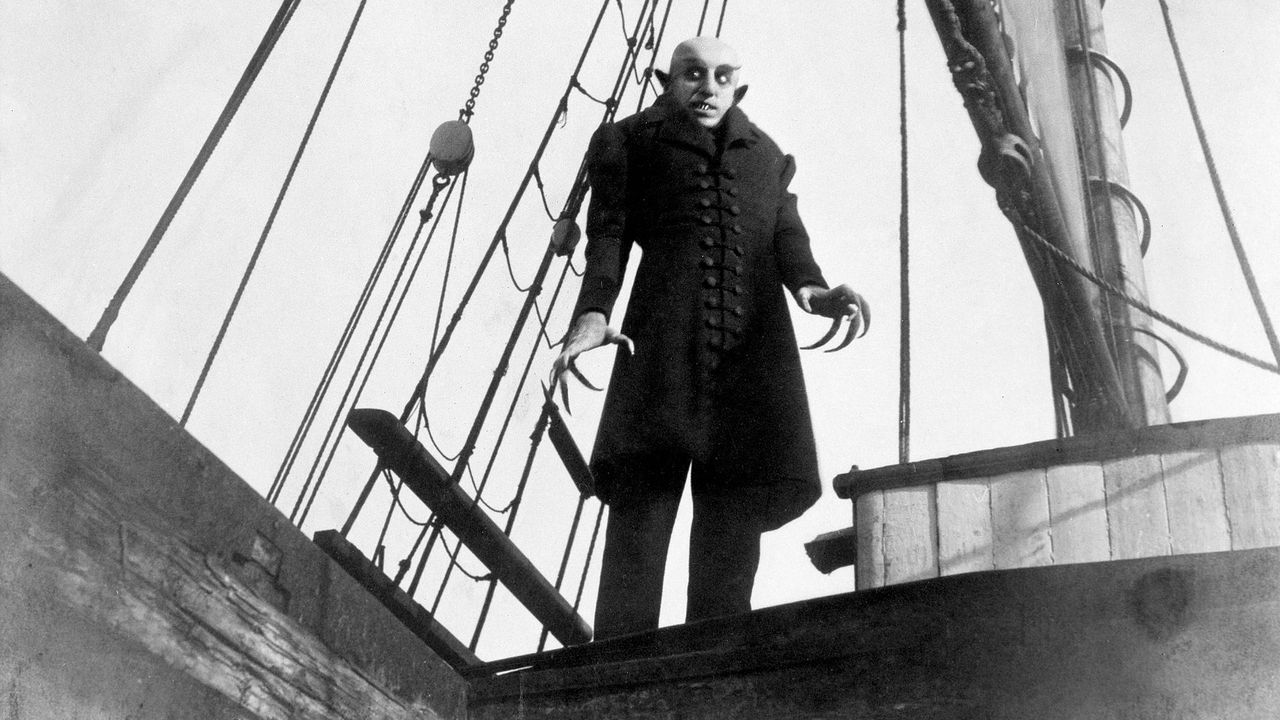
When we watch F.W. Murnau’s unauthorised adaptation of Dracula, Nosferatu (1922), we aren’t frightened by Count Orlok because he’s threatening objectively. We’re frightened because his world seems built just for him. The shadows pool as though they’re waiting for him, and the angles welcome him in.
The actor playing Count Orlok, Max Schreck – and yes, “Schreck” literally means “fright” in German (these people had a sense of humour about their nightmares) – moves through spaces which seem to exhale when he arrives. He doesn’t violate the world as though it was already his. The rest of us were just visiting.
Then there is the shadow work. Fritz Lang’s cinematographer Karl Freund knew that light in horror cinema is really a story about the absence of light. In Metropolis (1927), the shining upper city exists to throw the underground into contrast. Morally as well as visually.
Use of shadow by the Expressionists isn’t decorative, but diagnostic. It tells us where the power lives, and what it does when it thinks nobody is watching. The shadow of the monster arrives before the monster.
The shadow of Orlok’s hand creeping up that wall is more frightening than the hand itself, because that shadow is possibility. That shadow is every bad thing which could happen before it collapses into the one bad thing which does.
Horror cinema learned this lesson and hasn’t stopped using it. We can trace a direct line from the warped shadows of Caligari’s asylum to the Venetian blind stripes across the detective’s face in every noir ever made, to the green-lit digital rain of The Matrix (1999), to those long shadows falling across children’s bedroom floors in roughly six thousand modern horror movies.
German Expressionism & the Birth of Modern Horror
What Expressionism gave horror cinema was permission. Permission to not explain. The best horror never explains, and the Germans gave the medium its theological justification for mystery.
We never fully decode Dr. Caligari. There’s no backstory for Orlok. In The Golem (1920) from Paul Wegener, his clay man animated by a rabbi’s dark prayer doesn’t pause to discuss the metaphysics. These movies knew that explanation is the enemy of fear.
Consider how this plays out in the American horror golden age of the 1930s. Universal Studios really imported German Expressionism wholesale by importing the Germans. James Whale directed Frankenstein (1931) and hired German art directors. Director Tod Browning worked with Karl Freund directly on Dracula (1931).
Without exaggeration, the monsters of Universal horror are German Expressionist creations relocated to English-speaking sets. Dr. Frankenstein’s laboratory, with its impossible machinery and electrical arcs, is Caligari’s asylum with better costumes. That monster with bolts in its neck lumbering through villages is Nosferatu with a better publicist.
The Lasting
Legacy
Beyond shadows and angles, beyond techniques and the weaponisation of architecture, Expressionism gave horror cinema something more philosophically dangerous: an unreliable world.
At the end of Dr. Caligari, the realisation that the story has been narrated by a lunatic forever changed the relationship between the audience and the screen. The cinema wasn’t a window onto reality anymore. It was now a symptom.
Every horror film that plays with perception owes a debt to this move. Rosemary’s Baby (1968), The Others (2001), Hereditary (2018) and many others deploy the same Expressionist trick: maybe the world you’re watching is real. Maybe it’s the product of a broken mind. That ambiguity is the terror.
Some traumatised German artists in the aftermath of World War I decided to make movies that looked like psychological collapse. And because they did, they handed every filmmaker who came after the tools to make you truly afraid.
– They should have charged more.

Author
Adam Page is a freelance writer, specialising in film and literature with essays and opinion pieces. He has a particular love for all things horror-related, being published in HorrorFam, FilmEast, MovieMarker among others. He is an Undergraduate, studying English Literature and Language, and enjoys taking movies apart, discovering the themes and techniques used to make cinema the incredible medium it is. If he isn’t writing an essay, he is usually found rewatching a movie, notebook in hand and annoying anyone who is sitting close by. Feel free to follow him on Instagram and BlueSky.
Analog horror is a fascinating corner of the horror genre. They do not rely on modern special effects or glossy visuals. Instead, they aim lo-fi aesthetic, unsettling, glitchy…

German Expressionism stands out as one of the most distinctive styles in the era of silent film. Expressionism, as an artistic movement, originally emerged in poetry…
Giallo is a subgenre of horror-thriller films that started in Italy, characterized by its unique blend of murder mysteries, psychological horror, eroticism, and stylized violence….
In the 90s, fear was defined by excessive gore, dark settings, and monsters in masks that chased their often-adolescent victims around their white-picket lawns. American cinema…
Cinema as an art form, has the unique ability to challenge societal norms, push the boundaries of storytelling and provoke intense emotions. One of the most striking…
In the middle of the twentieth century, when American studios dominated and British cinema leaned toward realism, Hammer Productions revived the Gothic past…